
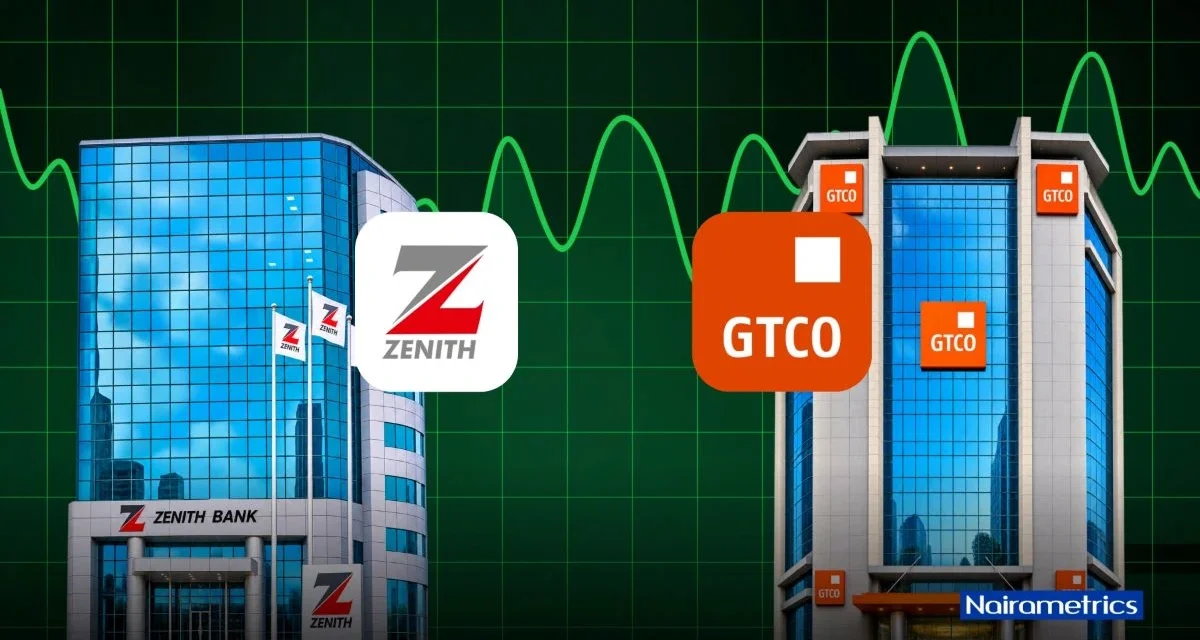

Guaranty Trust Holding Company (GTCO) and Zenith Bank closed the primary 9 months of 2026 with nearly comparable pre-tax earnings, however the numbers reveal two very totally different approaches to getting cash.
GTCO seems to be defending its stability sheet, decreasing lending publicity and retaining dangerous loans below management.
The trade-off is that rising funding prices are squeezing its core curiosity earnings.
Zenith, in the meantime, is increasing lending extra aggressively and producing stronger charge revenue.
But this development is coming with a rise in loans already exhibiting indicators of credit score deterioration.
For traders, that creates a selection between GTCO’s extra conservative stability sheet at the next valuation and Zenith’s stronger mortgage development at a less expensive valuation however with larger credit score danger.
GTCO trades credit score danger for funding strain
GTCO reported a pre-tax revenue of N879.90 billion, down 2.3% from N900.80 billion a yr earlier, whereas revenue after tax declined 12.2% to N614.57 billion.
The weak spot was not as a result of GTCO was incomes much less curiosity.
- Total curiosity revenue elevated about 5% to N1.29 trillion. The drawback was the price of producing that revenue.
- Interest expense jumped 27.7% to N356 billion, inflicting web curiosity revenue to fall 1.7% to N935.88 billion.
- Customer deposits had been the largest supply of strain, with curiosity paid on them rising to N325.25 billion from N228.18 billion, a rise of about 43%.
In easy phrases, GTCO has extra deposits, however these deposits are costing considerably extra.
The group can be lending much less. Net buyer loans declined 4.1% from December to N3.00 trillion, whereas its funding securities stood at about N5.94 trillion.
- Only about N434.51 billion, or roughly one-third of GTCO’s N1.29 trillion curiosity revenue, got here immediately from buyer loans. A a lot bigger proportion was generated from money placements and funding securities.
Management seems snug with that place.
Commenting on the outcomes, Group CEO Segun Agbaje mentioned the group remained centered on sustaining a “strong, liquid and well capitalised” stability sheet.
More importantly for traders, he mentioned GTCO would proceed to optimise risk-free returns and benefit from market alternatives with out compromising the standard of its danger belongings.
That remark helps what the stability sheet already exhibits: GTCO just isn’t chasing mortgage development on the expense of credit score high quality.
- Non-performing loans declined to N123.16 billion from N160.30 billion, decreasing the NPL ratio to roughly 4% from about 5% in December.
- Loan impairment fees additionally fell 58.4% to N29.02 billion.
Overall, that technique helps cut back credit score publicity, but it surely introduces one other danger. If rates of interest decline additional, returns from securities can fall whereas deposit prices might take longer to regulate.
Zenith pushes more durable into loans
Gross buyer loans elevated about 10.8% from December to N12.26 trillion, whereas buyer deposits rose 11.4% to N27.11 trillion.
Customer lending stays central to its earnings. Interest earned from buyer loans elevated to N1.44 trillion, accounting for greater than half of Zenith’s complete curiosity revenue.
Management describes this growth as deliberate.
Group Managing Director Adaora Umeoji mentioned the nine-month efficiency mirrored growing contributions from “customer-driven business activities”, highlighting development in lending, transaction volumes and buyer deposits.
She additionally mentioned decrease funding and credit score prices supported profitability and improved earnings high quality.
The funding numbers help that time.
Although Zenith’s curiosity revenue fell 4.5% to N2.62 trillion, curiosity expense declined 15.4% to N688.73 billion.
- Its price of funds fell to three.5% from 4.5%, serving to web curiosity revenue stay broadly flat at N1.93 trillion.
- Fee revenue supplied one other brilliant spot. Net charge and fee revenue elevated 26.6% to N256.85 billion, supported by digital banking, account upkeep, ensures and letters of credit score.
But there have been weaknesses; buying and selling revenue swung from a N277.65 billion achieve to a N229.19 billion loss, whereas working prices elevated.
Zenith nonetheless managed to develop pre-tax revenue 1.2% to N928.80 billion largely as a result of impairment fees collapsed 70.5% to N230.77 billion. Read Zenith Bank’s 9M 2026 outcomes
Loan development brings one other danger
The concern is that Zenith’s rising mortgage e-book can be carrying extra credit-impaired loans.
- Stage 3 loans elevated to roughly N600.56 billion from N422.41 billion in December, pushing their share of gross loans from round 3.8% to 4.9%.
There is a few stability in that image. Stage 2 loans, which have skilled elevated credit score danger however will not be but credit-impaired, fell considerably to N465.74 billion from N845.76 billion.
- Zenith additionally elevated its allowance towards Stage 3 loans to N450.42 billion, whereas its total protection ratio stood at 123.2% and capital adequacy at 24.5%.
Management says it stays centered on sustaining monetary energy whereas pursuing development.
Still, traders will wish to see whether or not the rise in Stage 3 loans stabilises earlier than concluding that the sharp discount in impairment fees is sustainable.
Credit high quality separates the 2
This is the place the distinction turns into sharper. GTCO’s non-performing loans fell to N123.16 billion from N160.30 billion, decreasing the NPL ratio to about 4% from 5%.
Zenith moved in the wrong way. Stage 3 loans elevated to about N600.56 billion from N422.41 billion, pushing their share of gross loans to roughly 4.9% from 3.8%.
- There was some enchancment additional up the credit-risk ladder, with Zenith’s Stage 2 loans falling to N465.74 billion from N845.76 billion.
Still, the rise in Stage 3 loans means traders ought to be cautious about treating the 70% decline in impairment fees as proof that credit score danger has absolutely normalised.
Which inventory looks cheaper?
Both shares have delivered good points to date in 2026, though Zenith has clearly outperformed GTCO.
- Zenith was up 94.17% year-to-date on the finish of October, regardless of falling 10.45% in the course of the month.
- GTCO was up 33.30% year-to-date, after declining 8.41% in October.
That means Zenith has already delivered the stronger capital achieve this yr, but it nonetheless looks cheaper on present valuation measures.
- At its October closing worth of N120, Zenith traded at about 4.67 occasions September 2026 trailing earnings and round 0.97 occasions e-book worth.
- GTCO, at N120.90, traded at about 5.52 occasions trailing earnings and 1.27 occasions e-book worth.
Put merely, traders had been paying extra for every naira of GTCO’s earnings and shareholders’ funds than they had been for Zenith’s, despite the fact that Zenith had already recorded the a lot stronger share-price achieve.
- GTCO’s larger valuation can partly be linked to its cleaner mortgage e-book and extra cautious method to lending.
- Zenith presents stronger mortgage and charge development at a decrease valuation, however traders even have to contemplate the rise in credit-impaired loans.
For traders, the selection is subsequently not merely about which inventory is cheaper.
GTCO presents a extra conservative stability sheet however at the next valuation, whereas Zenith has delivered the stronger capital achieve and nonetheless trades at a decrease valuation.
Going into 2027, GTCO must carry down the price of deposits, whereas Zenith wants to point out that its increasing mortgage e-book can proceed producing earnings with out creating extra dangerous loans.