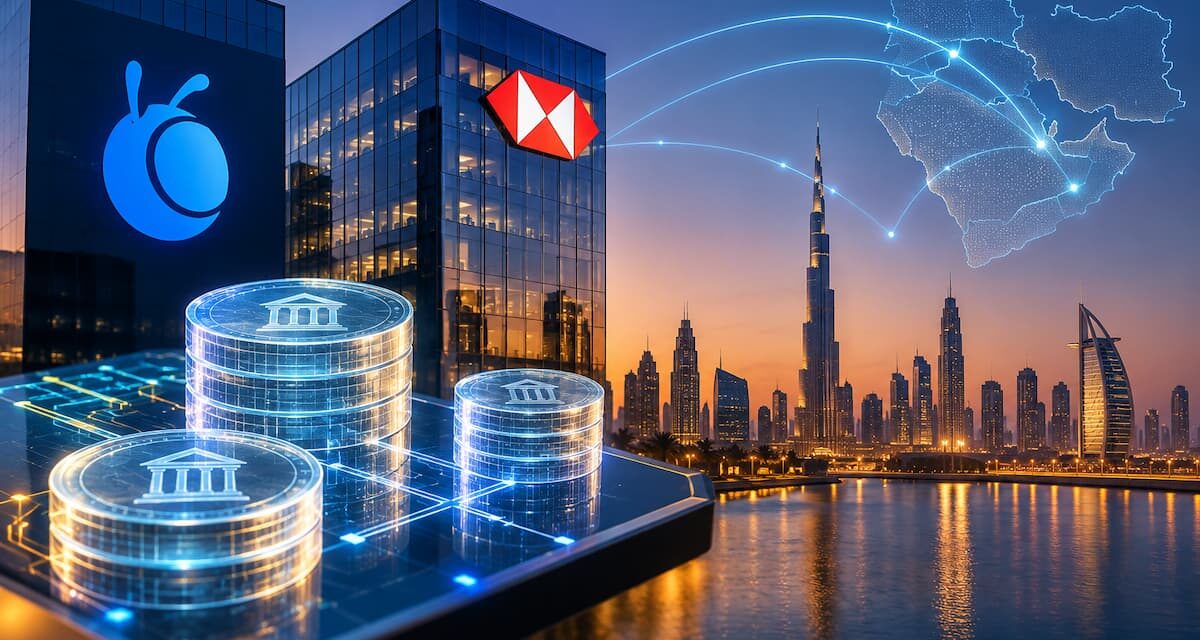

Ant International has expanded its real-time treasury administration operations into the Middle East by means of an enlarged collaboration with HSBC, finishing pilot transactions throughout two UAE-anchored fee corridors. The milestone makes Ant International the primary shopper within the area to use HSBC’s Tokenised Deposit Service (TDS).
The two corridors examined had been intra-UAE dirham transfers executed in actual time throughout the UAE, and cross-border US greenback funds initiated from the UAE and settled with counterparties in Hong Kong and Singapore. Both units of transactions had been initiated by means of WhaleRTP, Ant International’s proprietary blockchain-based treasury platform, and executed through HSBC’s TDS. The workflow was collectively designed by each establishments.
The infrastructure at play

WhaleRTP just isn’t a brand new product. Ant International has operated blockchain-based treasury infrastructure since 2019, deploying it throughout main monetary centres together with Hong Kong, Singapore, Europe and the United States. The platform is presently linked to greater than 20 international banking companions and handles real-time transfers in over 17 currencies, together with the US greenback, Hong Kong greenback and UAE dirham. The Middle East growth represents a geographic extension of a longtime operational layer fairly than a greenfield know-how deployment.

HSBC’s TDS, in the meantime, is now dwell in six markets: Hong Kong, Singapore, Luxembourg, the UK, the United States and the UAE. It helps seven currencies, together with the Chinese offshore renminbi, euro, pound sterling and dirham. Kyle Boag, HSBC’s regional head of worldwide funds options for the MENAT area, stated the service demonstrates “interoperability between tokenised deposit networks,” including that for company shoppers the sensible profit is the power to transfer liquidity throughout markets and monetary establishments with improved money visibility.
Kelvin Li, basic supervisor of platform tech and senior vp at Ant International, framed the transfer as a step towards establishing “a global treasury hub in the Middle East,” a commercially vital ambition given the area’s rising function in cross-border commerce and digital finance funding. Ant International’s operational footprint within the Gulf contains Alipay+, its service provider funds community, Antom, its fee gateway enterprise, and WorldFirst, its cross-border funds platform for small and medium enterprises.
Regulatory and market context
The growth sits at an intersection that regulators within the Gulf are actively creating. The UAE’s Virtual Assets Regulatory Authority and the Dubai Financial Services Authority have each issued frameworks overlaying digital asset exercise, and the Abu Dhabi Global Market has individually been working to entice institutional blockchain infrastructure. Tokenised deposits, which characterize industrial financial institution cash on a distributed ledger fairly than a brand new foreign money or a stablecoin, sit in a cleaner regulatory class and don’t require the identical licensing as a digital asset change or a digital asset service supplier. That distinction is significant for corporates with conservative treasury mandates.
More broadly, institutional tokenised deposit infrastructure is gaining traction as a mechanism for fixing sensible cash-management issues, significantly 24/7 liquidity entry and the power to settle throughout time zones with out the credit score and settlement danger related to correspondent banking chains. HSBC joins JPMorgan, Citi and Standard Chartered in working dwell tokenised deposit or intraday liquidity networks, although the particular foreign money and geography protection differs throughout every platform. The aggressive query for the HSBC and Ant International partnership is whether or not the joint workflow can entice third-party company shoppers past Ant International’s personal associates, and whether or not the dirham hall turns into a template for additional Gulf Cooperation Council currencies.
AI stage 1 of 5: written by Darlyn Ho; AI helped with tone, construction or wording; edited and signed off by Mark Walker, Editorial Director. What the levels mean