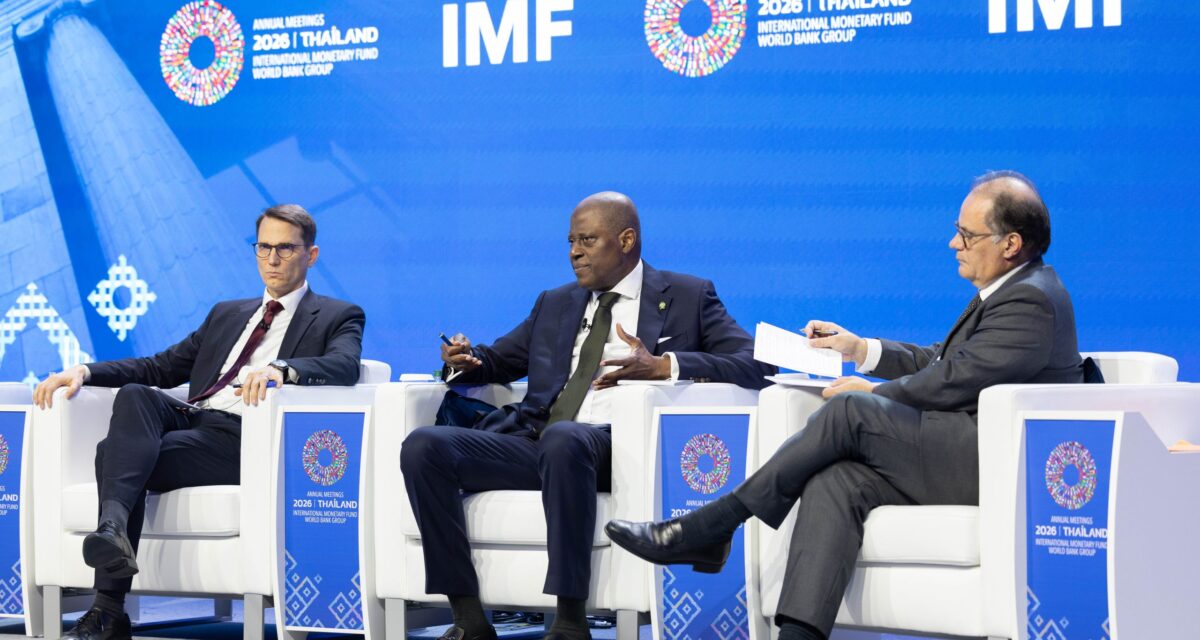

Governor of the Central Bank of Nigeria (CBN), Olayemi Cardoso, has emphasised that credible financial coverage relies on knowledgeable committee deliberations, impartial views and clear communication of choices to monetary markets and the general public.
Speaking at an International Monetary Fund (IMF) seminar in Bangkok on Thursday, Cardoso defined how the CBN has strengthened these practices inside its Monetary Policy Committee (MPC), drawing on Nigeria’s expertise of navigating advanced financial reforms and restoring confidence in financial policymaking.
The seminar, ‘How Central Banks Decide: Committee Decision-Making and Communication in an Era of Uncertainty,’ introduced collectively Cardoso; Chairman of the Swiss National Bank’s Governing Board, Martin Schlegel; and Governor of the Banque de France and member of the European Central Bank’s Governing Council, Emmanuel Moulin. The dialogue was moderated by IMF First Deputy Managing Director, Dan Katz.
Addressing the function of committee members in reaching credible selections, Cardoso defined that the CBN supplies exterior MPC members with devoted technical help and alternatives to seek the advice of impartial specialists.
The financial institution additionally organises retreats involving specialists from different central banks and wider stakeholder engagements, permitting members to contemplate various financial views past formal coverage conferences.
These preparations lengthen to Nigeria’s ongoing transition in the direction of inflation concentrating on, supported by IMF technical help, with exterior members concerned from the outset of the method.
Cardoso mentioned the preparations had been significantly essential in establishing the credibility of the MPC following the financial and institutional challenges confronting the CBN when the present management assumed workplace.
He additionally highlighted the financial institution’s apply of publishing particular person MPC members’ coverage statements, which supplies higher transparency across the reasoning behind financial coverage selections.
According to Cardoso, he personally critiques the statements to know the completely different assessments informing committee deliberations, together with opinions which will differ from the eventual determination.
On the function of management, he defined that efficient deliberation requires figuring out areas of settlement earlier than addressing disagreements and continuing to a vote.
“What are the things we all agree on? That should be number one. What are the things we don’t really agree on? And then number three, of course, is to vote,” he mentioned.
Cardoso famous that this strategy helps forestall committees from changing into absorbed in comparatively minor disagreements whereas dropping sight of the broader financial questions requiring selections.
His remarks mirrored a central theme of the IMF dialogue: how central banks can encourage rigorous inside debate whereas sustaining a coherent institutional place.
Schlegel described the Swiss National Bank’s strategy, the place governing board members study the deserves and downsides of competing coverage choices earlier than reaching consensus. The establishment communicates a typical place with out attributing particular person votes, a apply he mentioned additionally helps shield members from exterior strain.
Moulin mentioned the European Central Bank’s consensus-building tradition below President Christine Lagarde, highlighting inclusive deliberations, equal entry to info and a shared financial coverage framework. He harassed that communication should assist households perceive the implications of coverage selections for costs, employment and borrowing prices.
Cardoso illustrated the appliance of Nigeria’s strategy by way of the September MPC assembly, when members agreed that weaknesses within the financial coverage transmission mechanism required correction.
That frequent evaluation helped focus deliberations on the suitable response, leading to a 350-basis-point discount within the benchmark rate of interest from 26.5 per cent to 23 per cent.
He defined that Nigeria’s distinct inflation cycle, influenced by foreign-exchange harmonisation and subsidy reforms, required the committee to evaluate home financial situations reasonably than merely comply with financial coverage developments in different international locations.
Although the choice stunned markets, Cardoso mentioned earlier reforms, stronger financial fundamentals and thoroughly thought of communication helped buyers perceive its rationale.
“To do such a thing successfully, you must have an element of credibility with the market,” he mentioned.
Katz noticed that monetary markets absorbed the sudden determination with out vital disruption, describing the response as a testomony to the readability and credibility of the CBN’s communications.
The dialogue additionally examined the rising function of synthetic intelligence in decoding central financial institution statements. Schlegel emphasised the significance of exact language, whereas Katz disclosed that the IMF had developed AI instruments to analyse financial coverage communications in close to actual time.
In closing, Katz famous that though central banks function below completely different governance preparations, efficient decision-making relies on candid debate, various views, robust management and clear communication.
Cardoso’s contribution supplied Nigeria’s expertise of mixing impartial participation, clear coverage assessments and structured committee deliberations with the duty to speak collective selections clearly.
The change highlighted how the credibility of financial coverage is formed not solely by the selections central banks announce, but in addition by the institutional processes by way of which these selections are reached.