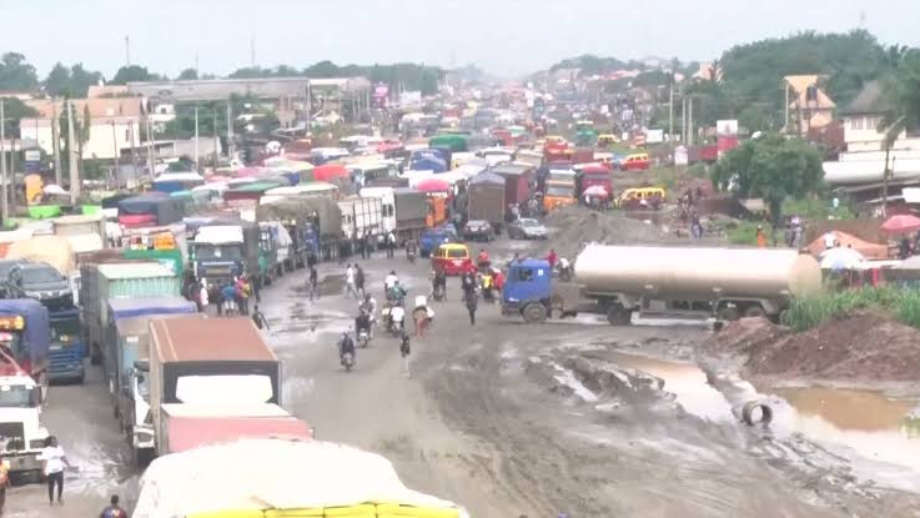

Minister of Works Engr. David Umahi has introduced the return of the Benin-Asaba Road to the Federal Ministry of Works, disclosing that President Bola Tinubu had directed the excellent redesign and full reconstruction of the 136-kilometre freeway as a twin carriageway.
The minister in an announcement by his particular assistant on media Mr Francis Nwaze additionally introduced remedial measures that are ongoing on essential sections of the Benin-Asaba highway, assuring motorists that everlasting strengthened concrete pavement works would start.
He disclosed this in the course of the reopening of the First Niger Bridge on the Asaba-Onitsha Road on Thursday.
The minister described the event as a serious step in the direction of resolving the longstanding challenges confronted by motorists travelling between the South-South and South-East, noting that the return of the highway to the Ministry of Works would allow the federal authorities to take direct accountability for its reconstruction.
“What stopped the Ministry of Works from reconstructing Benin-Asaba Road, the concessioning of that route has been unsealed. We now have our route back to the Ministry of Works,” Umahi declared.
He disclosed that President Tinubu had directed the overall and complete redesign of the highway as a twin carriageway, including that the design course of was ongoing and building would start upon its completion.
The announcement got here because the minister outlined the federal authorities’s intervention to guard and rehabilitate the First Niger Bridge, a strategic transport hyperlink connecting communities and companies throughout the South-East and South-South.
Umahi defined that the Ministry of Works responded after a content material creator alerted the federal government to actions threatening the structural integrity of the bridge.
An inspection subsequently revealed that some people have been eradicating bolts and reducing iron elements from the metal construction, actions he described as harmful and able to inflicting a bridge collapse.
He famous that the bridge was initially constructed and commissioned in 1966 by Nigeria’s then Prime Minister, Sir Abubakar Tafawa Balewa, however had suffered from insufficient upkeep over time.
According to the minister, the federal government has undertaken rehabilitation works just like these carried out on Lagos’ Third Mainland Bridge, together with asphalt resurfacing and median demarcation. He defined that the demarcation was obligatory as a result of bridges weren’t designed to face up to static masses indefinitely.
The ongoing security enhancements embrace the set up of CCTV cameras, solar-powered lighting and remark centres at each ends of the bridge. Security personnel will use the amenities to observe actions on and beneath the construction, whereas three turnaround passages have been created to assist motorists manoeuvre safely within the occasion of a automobile breakdown.
“Exactly the treatment we gave to the Third Mainland Bridge is the treatment we gave to this place,” Umahi stated, explaining that the federal government was making use of established rehabilitation and monitoring measures to guard the bridge and enhance security for highway customers.
He counseled the contractor, SKCC, for its work however clarified that the rehabilitation was not but 100 per cent full. Outstanding works embrace repainting the whole metal construction, finishing the upkeep of rust-affected areas beneath the bridge deck, putting in CCTV cameras above and beneath the bridge, and offering canopies at each ends.
The Minister additionally issued a robust warning towards unlawful sand dredging round bridges, reminding the administrators of the Federal Ministry of Works in Delta and Anambra States that federal rules prohibit sand dredging inside a 10-kilometre radius of bridges.
He warned that disciplinary motion would observe if the criminal activity continued, directing the state administrators to report any failure by safety companies to implement the rules.
Beyond the First Niger Bridge and the Benin-Asaba Road, Umahi highlighted different main infrastructure tasks throughout the South-East and South-South, describing them as a part of President Tinubu’s wider dedication to nationwide infrastructure growth.
He disclosed that the President had directed the reconstruction of roughly 400 kilometres of the East-West Road, which traverses the Niger Delta, from the Benin axis by the South-South to Cross River State.
According to Umahi, the mission would function a spur of the 750-kilometre Lagos-Calabar Coastal Highway, one other main infrastructure mission beneath the Tinubu administration.
“Some people thought that the East-West Road was a road in the South-East, and they started talking, trying to intentionally impinge the South-South brothers with the South-East brothers. East-West Road is entirely in the Niger Delta,” he stated.
The Minister dismissed solutions that building on the Lagos-Calabar Coastal Highway had stopped, explaining that work remained ongoing and that the remaining sections in Bayelsa and Cross River can be taken up within the coming weeks.
We’ve obtained the sting. Get real-time reviews, breaking scoops, and unique angles delivered straight to your cellphone. Don’t accept stale information. Join LEADERSHIP NEWS on WhatsApp for twenty-four/7 updates →