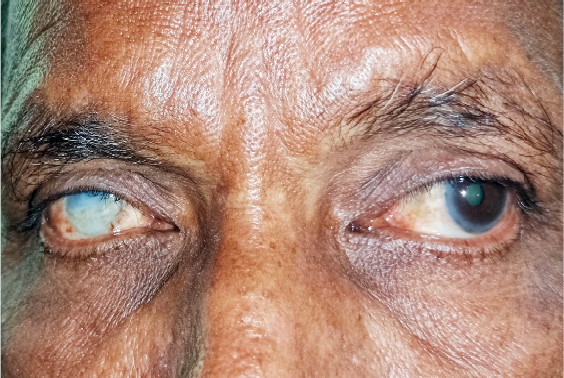
The lack of ability to see clearly goes past a medical downside. It can imply a baby falling behind at school, an grownup dropping the flexibility to work successfully, an aged individual turning into depending on relations, or a family sinking deeper into monetary hardship whereas in search of remedy.
Yet, eye well being has usually acquired much less consideration than different urgent public well being issues, leaving many Nigerians weak to preventable blindness and visible impairment.
With about 24 million Nigerians residing with imaginative and prescient loss, in line with figures cited by the federal authorities, the problem is gigantic. Cataracts, glaucoma, uncorrected refractive errors and different eye situations proceed to threaten the sight, productiveness and high quality of lifetime of hundreds of thousands.
For many affected Nigerians, entry to well timed analysis and remedy stays a problem, notably in underserved communities the place eye-care services, skilled personnel, gear and important providers could also be restricted.
Against this backdrop, the federal authorities known as for stronger private-sector funding to assist shut the gaps in eye care, cut back preventable blindness and construct a sustainable system able to assembly the wants of a inhabitants of greater than 200 million individuals.
At a stakeholders’ assembly in Abuja, the minister of State for Health and Social Welfare, Dr Iziaq Adekunle Salako, mentioned that eye well being ought to now not be handled solely as a priority for the well being sector, given its implications for schooling, employment, financial progress and nationwide growth.
According to him, good imaginative and prescient is key to how individuals be taught, work, work together with others and take part in society.
A toddler who can not see the classroom board clearly could wrestle academically with out receiving the suitable intervention. A employee with untreated visible impairment could discover it tough to carry out sure duties safely and effectively, whereas an older individual with cataracts could lose independence regardless of having a situation that could possibly be handled.
These penalties make eye care an essential element of human capital growth, with the potential to affect instructional outcomes, workforce participation and family welfare.
Salako due to this fact urged companies in banking, manufacturing, telecommunications, vitality and different sectors to recognise funding in eye well being as each a social duty and an financial choice.
He known as for modern financing preparations, together with blended finance, social impression funds, co-financing and concessional loans, to increase eye-care infrastructure and enhance entry to high quality providers.
The minister additionally urged firms to channel their company social duty investments into structured programmes, together with faculty eye-health initiatives, rural surgical outreaches and everlasting community-based eye-care centres.
Such an method, he indicated, might assist be certain that company contributions produce measurable and lasting advantages reasonably than stay restricted to one-off interventions.
One of the main questions going through Nigeria’s eye-health sector is how to make sure that providers stay accessible after particular person initiatives, campaigns or donor-funded interventions finish.
While free screenings and surgical outreaches can determine individuals with eye situations and supply rapid aid, sustainable eye care requires a broader system that helps early analysis, remedy, referrals, follow-up care and entry to important commodities.
Without reliable funding and practical service-delivery constructions, individuals recognized with eye situations throughout screening workouts should still be unable to afford the remedy they want.
This is especially essential for situations requiring specialised care, surgical procedure or continued monitoring.
To handle these challenges, Salako urged the non-public sector to help the growth of eye-care infrastructure and discover partnerships that mix public-sector management with non-public capital, technical experience and operational capability.
He additionally known as on growth companions and civil society organisations to offer technical help and innovation whereas serving to Nigeria transition from donor-dependent interventions to a regionally financed and accountable eye-health system.
The goal, he harassed, needs to be to construct a system that may present providers constantly, attain underserved populations and maintain progress over time.
For companies, this might imply supporting neighborhood eye-care centres, financing gear, offering reasonably priced providers or investing within the native manufacturing of important eye-care merchandise.
For authorities, it means creating an enabling surroundings by which these investments complement nationwide priorities and strengthen current well being constructions.
The Federal Government mentioned it’s already working to increase entry to eye-care providers by means of the JigiBola 2.0 initiative.
According to Salako, the programme, applied in partnership with stakeholders, has delivered greater than two million free eye screenings and 1.5 million free spectacles in simply over one 12 months.
It has additionally skilled greater than 2,200 major healthcare employees and activated over 800 major healthcare centres to offer fundamental eye-care providers throughout 16 states.
The subsequent section is anticipated to increase providers to a couple of million Nigerians in an extra 10 states.
The Renewed Hope Health Connect initiative can be focusing on 25,000 free cataract surgical procedures by 2027.
These interventions reveal the potential of mixing authorities programmes with partnerships to increase providers to individuals who may in any other case wrestle to entry care.
However, sustaining and increasing such efforts would require adequate funding, skilled personnel, practical gear and dependable provide chains.
The scale of the nation’s vision-loss burden additionally implies that authorities programmes alone will not be adequate to fulfill each want, reinforcing the significance of coordinated funding from companies, foundations and different stakeholders.
The problem is to make sure that new investments strengthen the nation’s well being system and increase entry equitably, notably for rural communities and low-income households.
Existing partnerships supply examples of how sustained company and philanthropic help can contribute to improved entry to eye care.
Salako counseled the longstanding partnership between First City Monument Bank (FCMB) and the Tulsi Chanrai Foundation, which he mentioned had reached greater than 400,000 Nigerians.
The initiative, often called the Priceless Gift of Sight, was launched in 2009 to offer eye-care providers to individuals in want.
In her opening remarks, FCMB’s Managing Director and Chief Executive Officer, Mrs Yemisi Edun, represented by Dr Diron Olojo, mentioned eye well being was not merely a medical concern however a vital element of schooling, productiveness, financial inclusion and human dignity.
She famous that preventable and treatable visible impairment continued to have an effect on people, households and communities, whereas gaps in consciousness, expert personnel, gear and entry to providers required sustained collaboration.
Edun mentioned the partnership with the Tulsi Chanrai Foundation had supplied free eye-care providers to greater than 400,000 Nigerians by July 2024 by means of eye testing, optical providers, surgical procedures and illness administration.
According to her, the expertise demonstrates the worth of long-term partnerships in delivering well being impression.
She urged contributors on the roundtable to determine communities and providers with the best unmet wants, develop sustainable financing plans with clearly outlined duties, and set up supply timelines and measurable indicators to strengthen accountability.
These priorities are vital to making sure that partnerships are assessed not solely by the amount of cash dedicated or the variety of individuals reached, but additionally by the standard, continuity and impression of the providers delivered.
For individuals residing in underserved communities, the boundaries to eye care could prolong past the supply of cash.
Distance to well being services, insufficient consciousness, shortages of skilled personnel and restricted entry to diagnostic gear can delay analysis and remedy.
These challenges make community-based providers and stronger major healthcare programs important to bettering entry.
The Head of Vision Care for Development Foundation, Mimansa Shulala, highlighted the significance of partnerships in reaching communities which are in any other case tough to serve.
She mentioned the muse, with help from Sterling Oil and in collaboration with different companions, had screened greater than 17,000 individuals over the earlier two and a half years.
More than 3,000 individuals requiring additional intervention had been recognized, whereas over 1,500 cataract and pterygium surgical procedures had been facilitated.
She additionally highlighted surgical interventions carried out in partnership with the Tulsi Chanrai Foundation at its Calabar facility.
According to Shulala, the target isn’t merely to offer remedy to people but additionally to strengthen authorities programs, develop native capability and set up a mannequin that may be sustained and expanded.
She defined that the partnership brings collectively completely different contributions: authorities offers management and programs, private-sector supporters present sources, the Tulsi Chanrai Foundation contributes technical experience, and the Vision Care for Development Foundation connects the programme with communities.
This mannequin illustrates how organisations with completely different capabilities can work collectively to deal with gaps that is perhaps tough for a single establishment to beat.
However, its wider impression will rely on whether or not such preparations could be replicated, adequately financed and built-in into broader eye-health providers.
Beyond funding remedy and increasing infrastructure, the Federal Government can be wanting in the direction of home manufacturing as a part of a broader technique to make eye care extra reasonably priced and accessible.
Salako challenged Nigerian producers to spend money on the native manufacturing of spectacle frames, lenses, ophthalmic medicines and different important consumables.
Greater home manufacturing, he mentioned, might cut back dependence on imported merchandise, strengthen native provide chains, create employment and help financial growth.
For sufferers, a stronger native provide of important eye-care merchandise might assist enhance availability and affordability, though the precise advantages would rely on manufacturing prices, product high quality, distribution and pricing.
Investment in manufacturing would additionally must be supported by acceptable requirements, regulatory oversight and a reliable marketplace for regionally produced items.
The minister urged telecommunications firms to discover how digital infrastructure might help tele-ophthalmology, distant screening and cell diagnostic providers.
These applied sciences might assist join individuals in distant places with eye-care professionals and enhance the identification of situations requiring specialist consideration.
Their effectiveness, nonetheless, would rely on enough infrastructure, skilled personnel, dependable referral pathways and the supply of remedy for sufferers recognized by means of distant providers.
We’ve obtained the sting. Get real-time experiences, breaking scoops, and unique angles delivered straight to your telephone. Don’t accept stale information. Join LEADERSHIP NEWS on WhatsApp for twenty-four/7 updates →