By Philomina Attah
The Nigeria Union of Journalists (NUJ), FCT Council, has sought a strategic media partnership with the Maryam Babangida National Centre for Women Development (MBNCWD) to advance girls’s empowerment and inclusion nationwide.
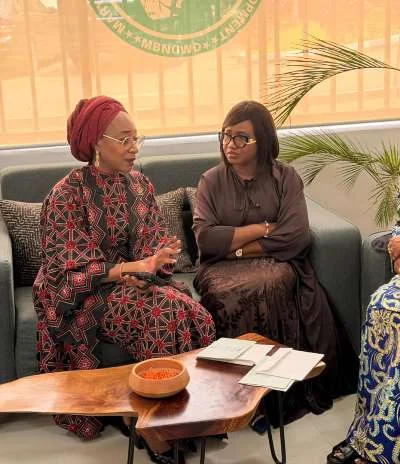
The Council’s Chairperson, Ms Grace Ike, made the decision on Friday in Abuja throughout a courtesy go to to the Centre’s Director-General, Dr Adedayo Benjamins-Laniyi, alongside different members of the delegation.
Ike, the Council’s first feminine chairperson, mentioned the delegation visited not merely for courtesy, however to determine a purposeful partnership aimed toward advancing girls’s growth via strategic media engagement and collaboration.
She mentioned the engagement was themed: “Women in Journalism: Centring Women’s Stories, Voices and Contributions for National Development,” highlighting the significance of documenting girls’s contributions to Nigeria’s progress and growth.
Ike questioned why the contributions of Nigerian girls who had formed households, the economic system, tradition and democracy remained inadequately documented, poorly archived and largely absent from the nationwide narrative.
“Where are the stories of grassroots women, rural women, women in informal work, women with disabilities and young women whose contributions rarely attract public attention?” she queried.
She mentioned the Nigerian Women Hall of Fame, domiciled inside the centre, must be seen not merely as a recognition platform, however as a dwelling archive preserving inspiration, proof and nationwide reminiscence.
“How can young girls aspire if they do not see themselves reflected in the history of their country? We are ready to work with the centre to tell these stories responsibly and consistently,” Ike mentioned.
The NUJ chairperson described the media as a strong instrument for shaping public opinion, influencing coverage and driving social change, emphasising journalists’ accountability to amplify girls’s voices and have a good time achievements.
She challenged the media and the centre to develop joint methods making certain points affecting girls, households and weak teams remained distinguished in nationwide conversations and obtained sustained public consideration.
“We must ask: Are women consistently visible in the issues shaping Nigeria today governance, economy, technology, security, education, health and climate change?
“Are we explaining policies in clear language and following up on whether commitments improve women’s lives?” she added, emphasising accountability and the necessity to assess coverage outcomes affecting girls.
She emphasised that regardless of progress, Nigerian girls continued to come across obstacles to alternatives, management illustration, financial empowerment {and professional} development, requiring sustained institutional dedication and collaborative motion to realize significant change.
Ike proposed common options and programmes on girls’s management, documentation of ladies’s histories, intergenerational dialogues and public conversations addressing empowerment, inclusion and digital participation throughout communities all through Nigeria.
Other proposed initiatives included inclusive protection of grassroots girls and ladies with disabilities, alongside joint capacity-building programmes equipping girls journalists with moral, gender-sensitive reporting expertise and improved skilled competencies.
“Can we create more opportunities for women journalists to contribute effectively to this mission? Can we strengthen female representation in leadership positions within the media and other sectors?” she requested, pledging sustained engagement.
She added that the council would designate a liaison officer to coordinate actions, facilitate communication and guarantee constant reporting, strengthening accountability and continuity all through the proposed media partnership between each establishments.
Responding, Benjamins-Laniyi counseled the council and accepted the proposal, declaring that the centre, which was marking its thirty fourth anniversary, was able to institutionalise collaboration round shared priorities and measurable outcomes.
She urged journalists to use gender and incapacity views to each project, asking: “Who is the woman in media with disability that you brought here to cover this event? Inclusion must be intentional, not symbolic.”
The director-general proposed 5 fast motion areas, together with a proper media partnership framework, bi-monthly fireplace chats, gender-responsive journalism coaching and institutionalised, data-driven accountability mechanisms to trace progress and outcomes.
She additionally invited the council to the forthcoming Women in Media Breakfast and actions marking the centre’s thirty fifth anniversary, together with the disclosing of a ramp and disability-friendly amenities.(NAN)
Edited byAbiemwense Moru